Interview scorecard: how to prepare one so you can give feedback afterwards
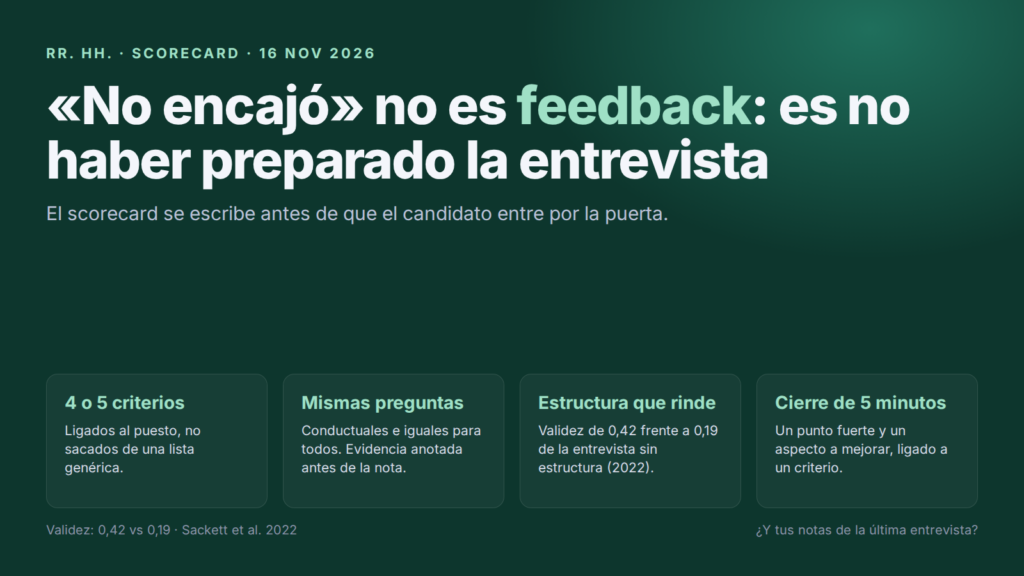
To be able to give feedback after an interview, the scorecard is prepared before the candidate walks through the door. Choose 4 or 5 criteria tied to the role, write the same questions for everyone and note evidence while they talk. With that, feedback comes down to a few sentences based on what was said, not on an impression.
What is a scorecard, and why is it the step before feedback?
A scorecard is an evaluation sheet with the criteria that matter for the role, a rating scale and space to note the evidence for each answer. Almost every guide presents it as a tool for making better decisions. That’s true, but it has another, less mentioned use: it’s what makes it possible to explain the decision to the person who wasn’t chosen.
Think of the moment a candidate asks you what they could improve. If all you have is a general feeling (“they didn’t quite fit”), there’s nothing to tell. A guide from smarthiring.tech sums it up: without a scorecard you can’t give useful feedback, because nobody wrote down why the person was rejected.
For the interviewer it’s a practical advantage. If the notes exist, feedback is a few minutes’ work. If they don’t, you’ll have to reconstruct from memory a conversation from a week ago, and you’ll most likely end up sending the usual generic formula.
How much does structure improve an interview?
The re-evaluation by Sackett, Zhang, Berry and Lievens, published in 2022 in the Journal of Applied Psychology, puts the average validity of structured interviews for predicting performance at 0.42, compared with 0.19 for unstructured ones, as reported by Test Partnership. The classic Schmidt and Hunter (1998) figures were 0.51 and 0.38. The numbers change, but not the conclusion: structure helps. Noon’s analysis explains the change in figures. These are averages, and there’s variation between studies and roles.
How many criteria should a scorecard have?
Between 4 and 5 is a good starting point when the scorecard also serves for giving feedback. A G-Talent guide on competency-based interviews proposes 5 to 7 critical competencies and warns that measuring too many reduces depth and makes it harder to compare candidates. We’d narrow it a little further: each criterion ends up as a sentence you’ll be able to give back to the person, and more than five makes the conversation unmanageable.
To choose them, start from the role, not a generic list. Ask yourself what someone in this position would need to do well in their first six months. Then drop whatever is “nice to have” and keep what’s essential. Common examples:
- Solving problems with incomplete information.
- Communicating clearly with people from other areas.
- Focus on measurable results.
- Technical knowledge for the role.
- Adapting to changing priorities.
Define what a good result means for each criterion
A 1-to-4 scale is of little use if each interviewer interprets a 3 their own way. Before interviewing, write one line describing what a high-level answer would look like and another for a low-level one. That way two different people score similarly, and you know what to say when someone asks why.
How is it filled in during the interview?
With the same questions for everyone, phrased as behavioural questions, and with notes of what the person said, not what you interpret. A behavioural question asks for a real case from the past. A hypothetical one asks for an opinion. As Aprende Psicología shows, it’s the difference between asking “What would you do if you had a conflict with a colleague?” and asking them to describe a time they had one and what they did.
The STAR method (situation, task, action, result) helps organise the notes. The key part is the action. When the candidate answers in the plural, it’s worth probing. Latin Human Capital suggests phrases like “What exactly did you do?” or “How did you measure the result?”
Terms used in this article
Scorecard: a sheet with criteria, questions, a scale and evidence. STAR: an answer structure with situation, task, action and result. Behavioural anchor: a short description of what a high- or low-level answer on a criterion would look like. Behavioural question: one that asks for a real example from the past.
One habit that makes a difference: write down the evidence (the specific phrase or fact) before giving the score. If you score first, it’s easy to then look for facts that justify the score. And leave the final score until the end, not after each answer, if you notice your first impression is influencing you.
What scorecard template can I copy?
This is a minimal structure. Duplicate the criterion block as many times as you need (4 or 5) and give it to every interviewer in the same form.
Header
- Role, date and interviewer.
- Candidate (name or code).
Block per criterion (repeat 4 or 5 times)
- Criterion: [for example, results orientation].
- Behavioural question (the same for everyone): [“Tell me about a demanding goal you achieved. How did you measure progress?”].
- High-level answer: [one line written before the interview].
- Low-level answer: [one line written before the interview].
- Evidence: [what they said or did, in their words].
- Score from 1 to 4.
Wrap-up (2 minutes after the interview)
- An observable strength you want to give back.
- One specific area to improve, observable and tied to a criterion.
- Decision: move forward, hold or don’t move forward.
How do you turn the scorecard into feedback in minutes?
Take the decision, the criterion that weighed most and one concrete observation from the process. Copilot Interview proposes that same sequence: the decision in the first line, the requirement not met, one specific observation and a close. It also advises avoiding comparisons with other candidates, comments on personality and vague formulas like “not the right profile”.
With the scorecard in front of you, the message almost writes itself:
Thank you for the time you put into the process. We’ve decided to continue with another candidate. The criterion that weighed most was [focus on measurable results]. In the example you gave about [the project], it wasn’t clear how you measured progress. If in future processes you bring a figure or an indicator for each example, your answer will be much stronger. We wish you luck.
Notice that it describes behaviour observed in the interview, not the person. That’s also the line drawn by the smarthiring.tech guide: safe feedback talks about observable behaviour. Timing matters almost as much as content: Indeed recommends sending it within a few days if possible.
If you’re a candidate: ask for the criteria, not their opinion
Asking for feedback after an interview is possible and simple, especially if you frame it well. Instead of “Why didn’t you choose me?”, try something like: “On which of the role’s criteria do you think I have most room to improve, and what example would have convinced you more?” It’s an easy question for the interviewer to answer, because they only need to look at their notes. And the clearer the company’s process, the easier it will be for them to tell you.
What about bias and risk when giving feedback?
A scorecard doesn’t eliminate bias, but it makes it more visible. When everyone answers the same questions and every score has evidence next to it, it’s harder for a personal affinity nobody could justify to tip the balance. IMECAF presents the structured interview precisely as a way to reduce bias in hiring.
On the legal side
What data you can keep, for how long and what you must tell candidates depends on the applicable rules, especially data protection law. This article isn’t legal advice. Before setting a feedback procedure at your company, check it with an employment law professional or your data protection officer.
To reduce risk in practice, pay attention to what you write down: facts and phrases from the interview, not adjectives about the person or assumptions about their personal situation. “Didn’t specify the project’s result” is better than “not very ambitious”. The first can be explained and improved; the second can’t.
Where to start this week?
Our position is simple: feedback isn’t an extra you improvise at the end of the process, but a consequence of how you prepare the interview. If you have an interview this week, spend twenty minutes choosing four criteria, writing a behavioural question for each and defining what a good answer would be. After the conversation, set aside five minutes to complete the scorecard wrap-up. With that, everyone who goes through your process can receive more than a standard formula, and you’ll have clearer criteria for deciding.
Frequently asked questions
How many criteria should an interview scorecard have?
To give feedback comfortably, 4 or 5 is reasonable, each tied to a real requirement of the role. Some competency-based interview guides use 5 to 7, but warn that measuring too much reduces depth. The fewer the criteria, the easier it is to compare candidates and give back a clear message.
Can you give useful feedback without having prepared a scorecard?
You can, but it will be less specific and harder to justify. Without criteria or notes taken during the interview, feedback depends on memory and general impression. If you don’t have a scorecard, write down one piece of evidence for each criterion you assessed as soon as possible after the interview, and build the message from there.
How long does it take to prepare and fill in a scorecard?
The initial preparation for a role usually takes about 20 or 30 minutes: choosing criteria, writing questions and defining high- and low-level answers. It’s reused in every interview for that vacancy. During the interview it’s filled in live, and the wrap-up takes a few minutes. These are practical estimates and will vary by role.
