Which questions not to ask in an interview (and what to ask instead)
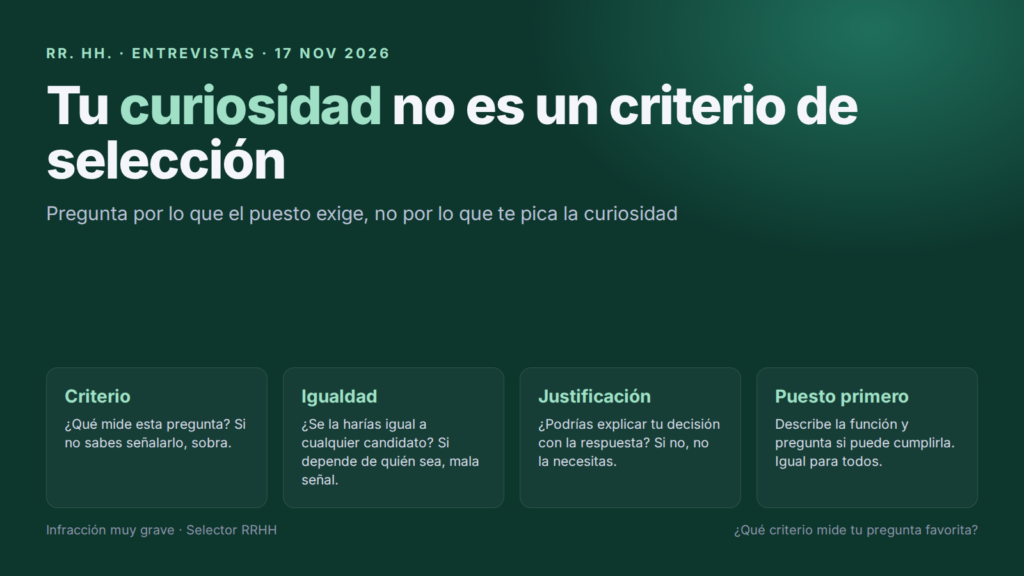
Don’t ask any question you can’t connect to something the role genuinely needs. That rules out age, beliefs, political affiliation, family life and health, among other topics. For each of them there’s a substitute question that gets you the useful information without intruding on the candidate’s personal life. The sources and rules cited here are Spanish; check the law that applies where you hire.
How do I know whether an interview question is safe?
Almost every guide gives you lists of prohibitions. We suggest a shorter filter that also works for cases no list covers. Before asking a question, answer three things for yourself:
- Which criterion for the role does it measure? If you can’t point to one (a competence, a function, a scheduling requirement), it doesn’t belong.
- Would I ask it the same way of every candidate? If it would depend on who’s in front of you, that’s a bad sign.
- Could I explain the decision using the answer? If the answer wouldn’t help you justify anything to the candidate, you don’t need it.
It’s the same idea set out by ObservatorioRH: the interviewer should focus on the candidate’s abilities and skills and their suitability for the role, and leave aside personal matters that barely affect performance.
Which topics are off-limits?
These are the ones that come up most often in specialist sources:
- Children and family plans. ObservatorioRH says the interviewer should avoid asking whether someone wants children, so as not to judge anyone’s suitability on that basis.
- Beliefs and political affiliation. According to RRHH Digital, these questions have no place in an interview.
- Disability and health. RRHH Digital recommends avoiding questions about disability to guarantee equal opportunities.
- Age, marital status, origin or sexual orientation. Selector RRHH explains that the company can’t request anything that implies unequal treatment on grounds of sex, racial or ethnic origin, language, age, marital status, disability or sexual orientation.
- Weight and height. According to Eroski Consumer, you shouldn’t ask about them unless the role requires special physical conditions.
Exceptions exist, but they’re narrow
A topic being off-limits doesn’t mean it can never be raised. Selector RRHH gives the example of a radiologist applying for a role that could affect her future baby, where asking about pregnancy would be relevant. Something similar applies to nationality: Deia notes it’s only appropriate when there’s a clear administrative reason, such as checking a work permit. If your case looks like an exception, check with an employment lawyer first.
What can I ask instead?
Here’s the gap almost every guide leaves: they tell you what not to ask and don’t give you the substitute question. The general rule is to replace curiosity with the requirement. If the role demands something specific, describe it and ask whether the candidate can meet it. Always do it the same way with everyone.
- Instead of “Do you have children or plan to?”, say: “The role involves [travelling two days a month / an afternoon shift / on-call duty]. Can you meet that requirement?” RRHH Digital accepts stating the vacancy’s demands as long as they don’t explicitly refer to family situation.
- Instead of “How old are you?”, say: “Tell me about a recent project with [tool or type of challenge] and the result you achieved.”
- Instead of “Are you married?” or “What do you do in your free time?”, say: “What availability do you have for this role’s working hours?”
- Instead of “Where are you from?” or “Do you have any health problems?”, say: “These are the role’s essential functions. Can you perform them, with or without adjustments?” If you need to check work authorisation, treat it as an administrative step, the same for everyone.
- Instead of “Who do you vote for?” or “What religion do you practise?”, say: “Tell me about a time you had a serious disagreement in a team and how you resolved it.”
- Instead of “How tall are you?” or “How much do you weigh?”, say: “The role requires [lifting X kilos / standing for six hours]. Can you do that?” Only if that physical requirement genuinely exists.
Notice that every alternative has a “role first” version: it describes what will be done and asks for evidence that it can be done. Before using them in a real process, review them with your employment adviser or your data protection officer.
What about the candidate’s social media and documents?
The limits don’t end in the interview room. Prevención Integral recommends distinguishing whether a profile is professional or private, collecting only information that is necessary and relevant to the role, informing the candidate before processing that data and deleting it once they’re rejected. In addition, as reported by Restauración Colectiva, Spain’s data protection agency (AEPD) warns that candidates aren’t obliged to let the employer look into their social media.
Something similar applies to documents. Prevención Integral says that providing an employment history report must always be voluntary, and that, as a general rule, the company has no right to demand a criminal record, with some exceptions.
What the rules say about penalties
According to Newtral, the topics barred in an interview are set out in article 16 of Spain’s law on social-order infringements and penalties, and in July 2022 the Ministry of Labour tightened the rules on health questions. Selector RRHH adds that the law treats requesting personal data in hiring processes, or setting discriminatory conditions for access to employment, as a very serious infringement. To find out how this applies to your company, consult a professional.
What does all this have to do with giving feedback?
Much more than it seems. When you only ask about criteria defined before you start, your decision comes already explained. You can tell the candidate: “We were looking for three things: experience in X, the ability to do Y and availability for Z. On Y we saw less evidence than in other profiles.” That’s useful, defensible feedback.
If, on the other hand, you let curiosity lead, you’re left with information you can’t use in the explanation. In that case you’ll most likely end up with silence or a generic message. Giving and asking for feedback after an interview is possible and simple, as long as there’s a criterion behind it.
On candidate data, Selector RRHH points out that it must be deleted once the candidate is rejected or, at the latest, when the process ends, and that the CV can’t be kept for future processes without their consent. Ask your data protection officer how long you can keep your evaluation notes.
What’s our position?
Curiosity is human, but the interview isn’t the place to satisfy it. A well-run interview is short on questions and long on criteria: a few clear requirements, the same questions for everyone and notes that help explain the decision. If a question seems interesting but you don’t know which criterion it measures, keep it to yourself. The candidate will have a better experience and your company less risk. And you’ll have something concrete to say when they ask for feedback.
Frequently asked questions
Can I ask a candidate whether they can travel or work shifts?
Yes, if it’s a real requirement of the role and you ask every candidate in the same way. ObservatorioRH points out that companies can make sure the interviewee can carry out the vacancy’s essential functions. What you should avoid is linking the question to their family situation.
Can I look at a candidate’s social media?
With caution. Prevención Integral advises assessing whether the profile is professional or private, collecting only what’s relevant to the role and informing the candidate beforehand. Check with your data protection officer before including it in your process.
What can a candidate do if they’re asked an off-limits question?
According to INEAF, they have three options: not answer, answer or report it. InfoJobs suggests another route: not answering, but clarifying with the interviewer what they want to know about the role. If in doubt, consult an employment lawyer.
