How to say “no” with useful feedback: what to say and what to avoid
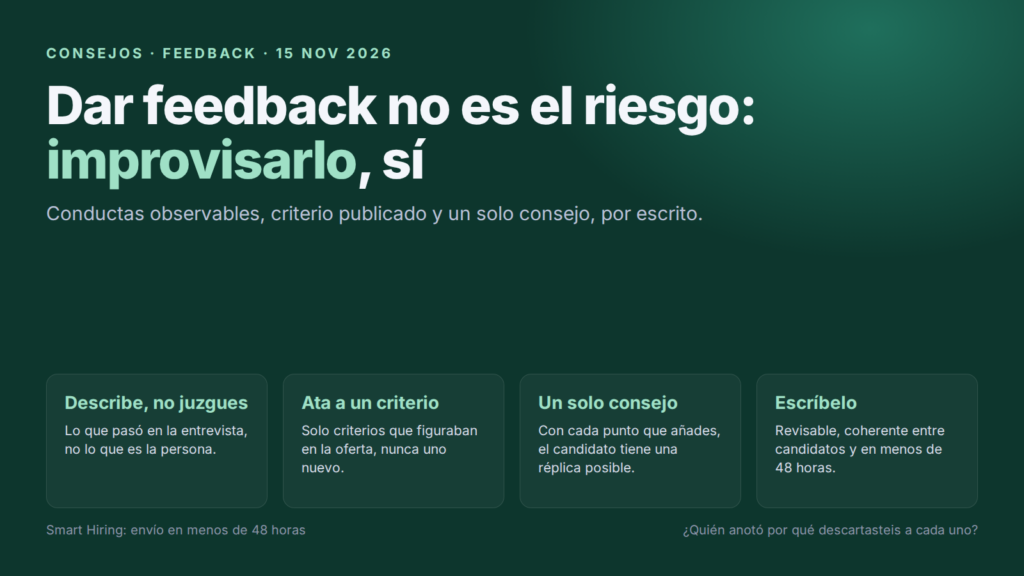
A “no” with useful feedback explains the decision with observable behaviour from the interview, compares it with the criteria listed in the job ad and is limited to a single tip, preferably in writing. What exposes you isn’t giving feedback, but improvising it with judgements about the person. With that structure the message is harder to misread, and the candidate takes away something they can use.
Is giving feedback after a “no” a legal risk?
According to Smart Hiring, in most jurisdictions there’s no obligation to give it, and giving it isn’t a risk in itself. The risk lies in feedback that describes the person rather than their behaviour, or that cites a criterion that was never published.
There are nuances. Fortune quotes an employment lawyer’s view: lawyers don’t usually recommend giving feedback, and if you do, it’s best to focus on the essential functions of the role. WorkHQ considers legal risk the main one and points out that someone can challenge the decision even if you’ve explained it clearly.
Staying silent doesn’t remove the problem either. According to YourERC, without factual feedback the candidate tends to invent their own explanation of why they were rejected.
A note on sources and the legal framework
Many of the guides we consulted come from English-speaking contexts, and the rules in Spain or elsewhere may differ. This article isn’t legal advice. Before setting a feedback policy at your company, or when facing a specific case, consult an employment law professional or your legal advisers.
Which phrases help and which expose you?
The practical rule is to describe what happened in the interview, not what the person is like. EasyHire recommends focusing on role competencies, citing observable behaviour, linking back to the job description and avoiding any protected characteristic. Here’s how that translates into phrases:
- Better not: “You don’t have the profile.” Better: “In the case study you didn’t get to prioritise by impact, and that’s one of the criteria for the role.”
- Better not: “You’re not a cultural fit for the team.” Better: “We were looking for experience managing your own budget, and the examples you gave were from projects with no budget responsibility.” EasyHire warns that subjective terms like “cultural fit” without concrete criteria are slippery ground.
- Better not: “We were looking for someone with more energy.” Better: “We needed examples of how you handle workload peaks and didn’t see them in the conversation.” Inside Sales Expert notes that the first phrase can be read as a reference to age.
- Better not: “We wanted someone with no commitments outside work.” Better: “The role requires availability during these specific hours, which were listed in the job ad.” Workable uses a similar example to show how a poor choice of words creates risk even with no intent to discriminate.
- Better not: “We’ve chosen someone better than you.” Better: “We’ve moved forward with another candidate who matched this criterion more closely.” EasyHire advises against comparing candidates in external communications.
- Better not: “We’ll keep you in mind for anything that comes up.” Better: “If we see a clear fit in the future, we’ll write to you”, and only if it’s true. EasyHire also advises against making promises about future employment.
This requires one step beforehand: the role’s criteria must be written down before interviewing, and someone must note why each person is rejected. Smart Hiring sums it up: if nobody wrote down the reason, there’s no feedback to give.
How do you keep the candidate from arguing?
By giving little and giving it clearly. Fortune suggests making it clear from the start that you won’t get into a debate, but that you do have time to offer a single tip. With only one point, it’s hard to open a new front. Comstock’s warns that with each point you add, the candidate may have a comeback.
If they still reply with arguments, you can close without a fight: “Thank you for the clarification. The decision for this process is final, but I’ll note it for future assessments.”
Phone or in writing?
The sources disagree. Workable suggests giving feedback by phone so you don’t leave words in writing that could be used in a claim. Fortune warns that a call can be risky, because the candidate will ask questions you may not be prepared for. Our recommendation is to put it in writing: you can review it, keep it to the criteria and stay consistent across candidates. If your company has a different policy, check with whoever is responsible.
What goes into a mini feedback template?
If you’re looking for the full email text, you’ll find it in our rejection template post. Here is just the skeleton of the feedback block, which is the part that usually gets improvised. Smart Hiring describes safe feedback as context, two or three concrete details taken from the evaluation sheet, a single thing to work on and sending it within 48 hours. Adapted:
- Context: “Thank you for the time you put into the [role] process. We’ve decided to continue with another candidate.”
- Two concrete strengths: “You explained your method for [task] clearly, and your examples of [competence] were specific.”
- One thing to work on, tied to a published criterion: “One of the requirements was [criterion], and in the interview we didn’t see examples of [behaviour].”
- A close with no debate: “The decision for this process has been made. We’re sharing this in the hope that it helps you in the next ones.”
What if you’d rather say nothing?
Silence looks like the prudent option, but it also has a cost almost nobody mentions. Workable argues that candidates resent companies that don’t even tell them they’ve been rejected after an interview. Indeed notes that giving feedback isn’t mandatory, but it can influence how the news is received and reflect well on the brand’s reputation. The cost doesn’t show up on a balance sheet, but it ends up in reviews, in conversations between professionals and in candidates who never apply again.
If you’re on the other side, remember that asking for feedback after an interview is possible and simple. One sentence is enough: “Could you share one thing I could improve for future processes?” You’re asking for little and making it easy for the person who has to answer.
What’s our position?
“We’ve chosen another profile” isn’t neutral. It leaves the candidate with nothing to learn and your team with no clear way to explain its decisions. Giving feedback isn’t an act of generosity: it’s a practice you can prepare with written criteria, reviewed phrases and a clear limit. Have your template reviewed once by a professional and use it with every candidate equally. With that, your risk will have gone down and your employer brand will have gained.
Frequently asked questions
Is it illegal to give feedback to a rejected candidate?
According to Smart Hiring, in most jurisdictions there’s no obligation to give it, and giving it isn’t a risk in itself. What creates exposure is the content: judgements about the person or criteria that weren’t in the job ad. The rules vary by country, so for a specific case consult an employment law professional.
Which phrases should I avoid when giving feedback to a candidate?
Avoid judgements about the person (“you don’t fit”, “we were looking for more energy”), comparisons with other candidates, promises about the future you won’t keep and any reference to protected characteristics, such as age or sex. Replace them with observable behaviour from the interview, tied to the role’s criteria.
Is it better to give feedback in writing or by phone?
The sources disagree. Some recommend the phone so there’s no written record, and others warn that a call forces you to answer unexpected questions. Our recommendation is to do it in writing, with a single tip tied to a published criterion, although your company may have its own policy.
