Why companies don’t give feedback after an interview (and how to ask for it safely)
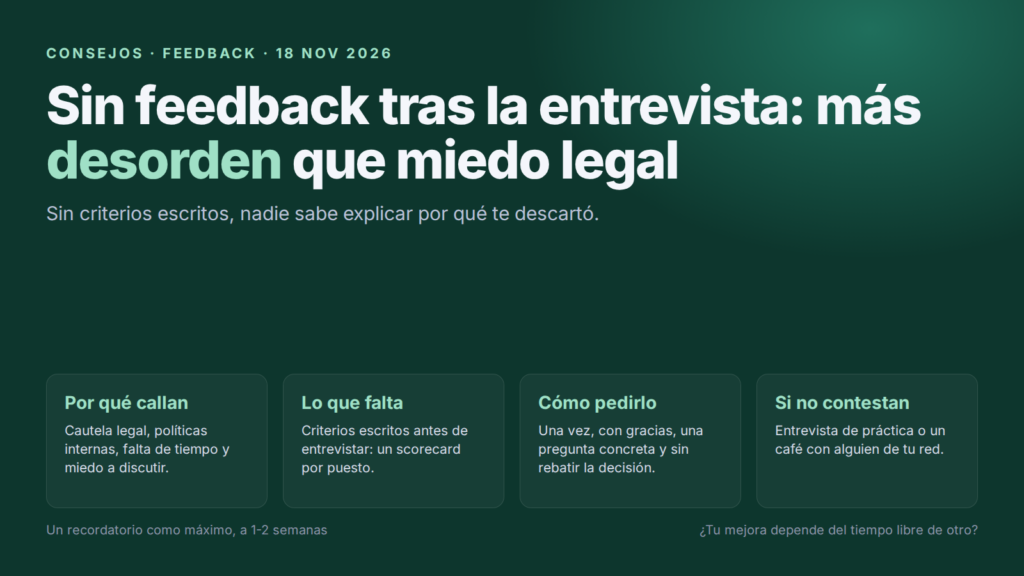
Most companies don’t give feedback after a rejection because of a mix of caution, lack of time and the absence of written criteria to back up the decision. Asking for it politely, once and through the process’s own channel shouldn’t hurt you: the worst that usually happens is that they don’t reply. And if they do, it may be the most useful part of the whole process.
Why does almost no company give feedback?
If you read career forums and blogs (most in English and focused on the US), the explanations repeat themselves. These are the most common:
- Caution about legal problems. Ask a Manager warns that some hiring managers will never give a rejected candidate feedback for fear of saying something that could end in a lawsuit.
- Internal policies. In a Blind thread, several users say some companies have an official no-feedback rule. That’s a forum perception, not verified data.
- Time and priorities. According to Ask a Manager, replying to rejected candidates is rarely a priority compared with everything else a manager has on their plate.
- Fear of an argument. Forbes reports that some companies fear detailed feedback will lead to long conversations or disagreements.
A note on the sources
Almost everything published on this subject comes from US forums, career blogs and media. The legal framework and hiring customs elsewhere, including Spain, may differ, so read these reasons as general practices, not an exact description of what happens at every company. If your question is a legal one, consult a professional.
Is legal fear the whole explanation?
Almost every source points to legal risk as the main reason. Our reading, based on experience hiring rather than on any study, is that the most everyday cause is far more mundane: there’s no time and nothing is written down. Silence is usually presented as a conscious decision to protect oneself, when it’s often simple disorganisation.
Think about it from the other side. After five interviews in a week, the interviewer remembers a general impression (“less of a fit”, “didn’t quite convince me”), but has no recorded criteria with which to explain the decision. Giving feedback would mean reconstructing it from memory, and that’s exactly what nobody wants to do for a candidate they’re not going to hire.
This is where a scorecard changes things. Google re:Work’s guide to structured interviewing proposes using standardised questions and rubrics to compare different candidates’ answers consistently. With that basis, the “no” comes half-written: two or three criteria for the role and what was observed for each.
What Google says about rubrics
According to the same Google re:Work guide, structured assessment tools with behaviourally anchored rating scales (what Google calls “rubrics”) predict performance better than unstructured interviews. It also says those who used them felt better prepared when interviewing. The guide doesn’t discuss feedback to rejected candidates: that connection is our reading.
We’re not saying the legal factor is made up: it exists, and each company decides how to manage it. But if fear were the only obstacle, a clear policy would be enough. What’s almost always missing is the material to give feedback with.
What’s reasonable to expect if you ask?
Adjusting your expectations saves you frustration. According to Ask a Manager, someone is more likely to reply after an interview than if you were rejected without speaking to anyone, because there’s already been direct contact. Even so, it warns that many managers won’t give genuinely useful feedback. You’re most likely to get a reply when the reason is simple and objective, such as experience that fell short of what the role required.
In practice there are four scenarios:
- No reply.
- A generic sentence (“we were looking for a different profile”).
- A specific comment you can use.
- With luck, also a recommendation or a lead on another opportunity. Ask a Manager acknowledges it happens, though it isn’t the norm.
The first three are normal. If you get the fourth, it’s a gift. Asking makes sense precisely because the cost is low and the potential benefit high.
Can asking for feedback hurt you?
What damages the relationship isn’t asking, but how you ask. In a letter to Ask a Manager, a candidate feared she’d burned bridges after demanding explanations, and the answer points to persistence and a complaining tone as the real problem. Elsewhere, the same outlet notes that if the hiring manager senses a desire to argue the decision, they’ll fall back on vague answers.
That gives three things to avoid:
- Arguing or trying to get them to reconsider the decision.
- Presenting feedback as something you’re owed. An Arcadia University guide puts it this way: you’re not in a position to demand it, only to ask kindly.
- Insisting several times in the face of silence.
If what worries you is a legal matter (for example, you suspect the reason for the rejection was discriminatory), this is no longer a question of etiquette: consult an employment lawyer, not a blog.
How do you ask without jeopardising a future application?
Asking for feedback after an interview is possible and simple if you make it easy to answer. These steps reflect what the sources agree on:
- Use the process’s channel. Reply to the same email or platform where you were told about the rejection. Some forums suggest bypassing the written channel and reaching the recruiter some other way; we don’t recommend it, because it can make people uncomfortable and doesn’t improve your chances.
- Say thank you first. Acknowledge the time they gave you before asking for anything.
- Ask a single, specific question. Forbes recommends a low-pressure request that can be answered in a few seconds, making it clear you’re not looking for a long conversation.
- Make your intention clear. For example: “Thank you for considering me. If it suits you, what specific area would you recommend I strengthen? I’m not looking to argue the decision, just to learn for future processes.”
- One reminder at most. If one or two weeks pass without a reply, the Arcadia guide suggests a polite follow-up and then moving on. Forbes advises accepting the silence after that point.
For the exact wording, there’s the three-line email. And if you get the chance to talk, the three questions help you get something useful out of a few minutes. We don’t repeat either here.
What if they don’t reply?
You have alternatives. Ask a Manager suggests asking a hiring manager you know to give you a practice interview, or inviting someone you connected with for a coffee and asking what you could do better. It’s feedback you choose, and it doesn’t depend on any internal policy.
What do we conclude?
As a candidate, always ask, but don’t depend on the answer: your improvement can’t be in the hands of someone else’s free time. Prepare each interview with your own notes on what you said and what you were asked, and treat them as your first source of feedback.
As a company, we believe the best starting point isn’t a communications policy but a scorecard per role. With criteria written down before interviewing, saying “no” with two useful lines stops being extra effort and becomes a by-product of the process. For specific legal questions, the sensible thing is to consult a professional, but that consultation works better when you already have something written down to ask about.
Frequently asked questions
Can asking for feedback after a rejection close doors for me?
Asking politely, once and without arguing the decision isn’t usually a problem; the sources agree that the risk lies in demanding, arguing or insisting. The most likely outcome is that they don’t reply, not that they penalise you.
How many times can I write to ask for feedback?
Once, and at most one short reminder after one or two weeks. If there’s still no reply, be quietly grateful and turn to other routes: a practice interview or talking to someone in your network.
What should I do if they say they don’t give feedback as a company policy?
Accept it calmly, thank them for the reply and don’t insist. Then look for feedback elsewhere. If you suspect the rejection may have been discriminatory, consult an employment lawyer.
