Ghosted after an interview: what to do when there’s no reply (and how to move on without waiting)
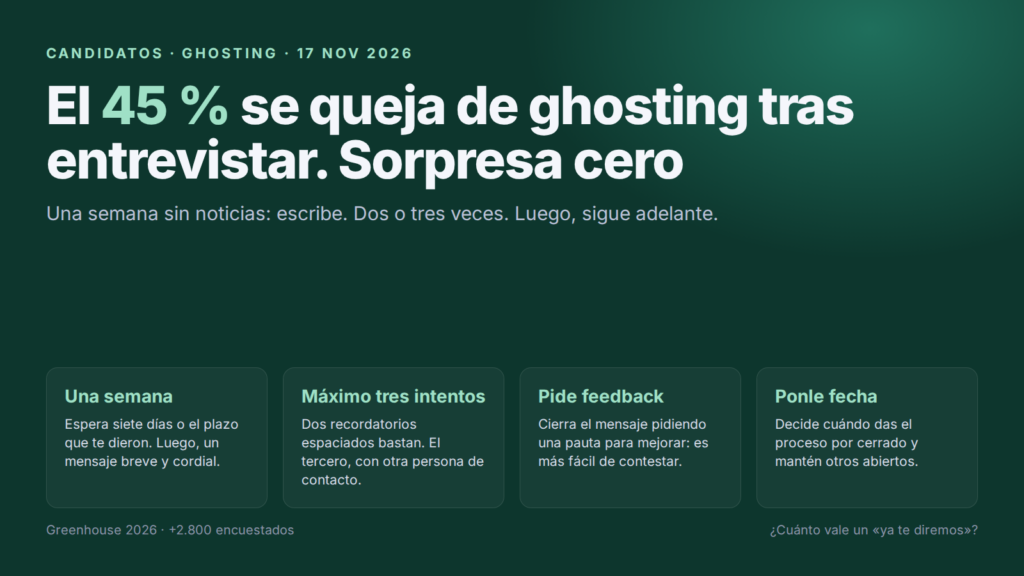
If a week has passed since the interview and you’ve heard nothing, send a short, friendly message to your contact. If the silence continues after one or two well-spaced reminders, treat it as an unannounced close and put your energy into other processes. It’s almost never a judgement on you: it’s usually lack of time, a process on hold or fear of saying the wrong thing.
When and how should I write to ask about the process?
The most common advice is to wait about a week. An article from COPE recommends writing, emailing or calling if you’ve heard nothing after seven days. Yahoo Finanzas agrees: after a week, get back in touch with the person who interviewed you, whether that’s the recruiter or the hiring manager. If you were given a timeframe in the interview, respect it before writing. You’ll find more detail on timing in our guide on how long to wait after an interview and how to read the silence.
A message that works is short, easy to answer and free of reproach:
Hi [name], thank you again for our conversation on [day]. I’m still very interested in the role and wanted to ask whether there’s any news or an estimated date for the decision. If the process has gone in another direction, I’d be grateful if you could let me know and, if possible, share a pointer to help me improve. Best regards.
It costs little to send, and the last sentence opens the door to something more useful than a “yes” or “no”: asking for feedback after an interview is possible and simple, and many people find it easier to answer that than an open question about the status of the process.
Why do companies go quiet when the process was already under way?
Silence after an interview is very common. In its 2026 candidate report, Greenhouse notes that almost everyone who got as far as an interview (96%) had at least one complaint, and the most common was employer ghosting, at 45%.
How to read that 45% figure
The figure comes from Greenhouse’s Future of Hiring Candidate Report 2026, a survey of more than 2,800 job seekers in the US, UK, Ireland, Germany and Australia, 1,200 of them in the US. It’s the percentage of those who interviewed and cited ghosting as a complaint, not a measure of how many processes end without a reply. Other publications give different figures depending on the market and the question: People Management reports 47% of candidates with no reply after an interview in the UK and Ireland (1,100 respondents), and Staffing Industry Analysts cites 63% in an earlier report from the same company. They should be compared with caution, because they don’t measure exactly the same thing. They’re also surveys by a recruiting software company, not official statistics.
The reasons the guides give are the same again and again, and almost none has to do with your worth:
- Lack of time. Aurora Jobs points out that an HR team can receive dozens or hundreds of applications per vacancy, and that a lack of staff dedicated to follow-up leaves candidates forgotten.
- Processes on hold. The same source points to internal changes: the vacancy is cancelled, an internal promotion is chosen or the team is reorganised, and sometimes nobody communicates it.
- Fear of saying the wrong thing. Randstad explains that some companies avoid giving a clear answer for fear of a negative reaction, and Forbes España notes that some recruiters and managers, even with good intentions, find it hard to give negative comments.
That last reason is the one least talked about. The interviewer usually knows you’re not moving forward, but doesn’t know how to say it without it sounding like a judgement, without opening an argument or without risking a misunderstanding. Staying quiet feels safe, even though for the candidate it’s the opposite. Understanding this doesn’t justify the silence, but it helps you not to read it as contempt.
How many times can I follow up without being a pest?
Two well-spaced reminders are usually enough, and three is the reasonable maximum. Telecinco reports that, according to several experts, you can ask for a reply up to three times before giving up, always with respect and professionalism. Yahoo Finanzas allows a third follow-up, with caution and depending on the circumstances.
A simple pattern
- First message, a week after the interview or after the deadline you were given.
- Second message, five to seven days later, with an equally friendly tone and a specific question.
- Third attempt, only if the role really matters to you: try a different contact (HR instead of the manager, or vice versa) and close with a kind sentence.
After that, stop writing. Insisting further gives you no new information and wears you down. COPE offers a practical reading: if they don’t answer after you’ve written, it generally means no.
How do I look after my self-esteem while they don’t reply?
Separate the professional from the personal. In the same COPE piece, a psychologist explains that it’s easy to think something about you wasn’t liked, and that it’s better to keep it on a professional level. He also warns that after many rejections your resilience is tested, and sometimes you need to pause for a while.
Some things that help in practice:
- Do your own review within 24 hours. Note which questions you struggled with, which answers went well and what you’d change. That way the interview is useful even if no reply comes.
- Put a date on the silence. Decide in advance when you’ll consider it closed, so you’re not living by your phone.
- Measure effort, not outcome. What you control is how many processes you have open and how much you learn from each one.
What should I do in the meantime to keep moving?
Don’t pin all your hopes on a single process. Infoposiciones recommends following up politely but without chasing, and diversifying with job boards, a well-maintained LinkedIn profile, direct contacts and more carefully prepared applications. A reasonable routine:
- Send your thank-you and follow-up message, and note the date you’ll do it.
- Keep at least two or three other processes active, even if you love the one you’re waiting on.
- Use each interview as a rehearsal: review your notes and adjust your answers for the next one.
- Ask for feedback when there’s an open door, without demanding anything and with a specific question.
- When the date you set arrives, close the process on your own terms and move on.
Is it worth waiting any longer for a reply?
Wait with a deadline, not with open-ended hope. Your job is to follow up clearly, kindly and within limits, learn from the interview and keep other processes going. A company not knowing how, or not daring, to close a process properly is a problem with its organisation, and it doesn’t change your worth or what you’ve shown. The reply may not come, but what you take away from each interview is up to you.
Frequently asked questions
How long should I wait before writing after an interview?
The usual approach is to wait a week after the interview, or after the deadline you were given if they mentioned one. If they said they’d reply within ten days, write once that time has passed, with a short, friendly message.
Is it normal not to hear back after an interview?
It’s more common than it seems. In its 2026 candidate report, Greenhouse found that ghosting was the most frequent complaint among those who got as far as an interview (45%). It’s usually due to lack of time, processes on hold or reluctance to give bad news, and doesn’t necessarily reflect your performance.
Can I ask for feedback if they haven’t replied?
Yes. Include a short, specific request in your follow-up message, for example a pointer to help you improve. They won’t always reply, but you make it easier for them to do so and you lose nothing.
