Rejection email template with feedback: four sentences that help, and what to avoid
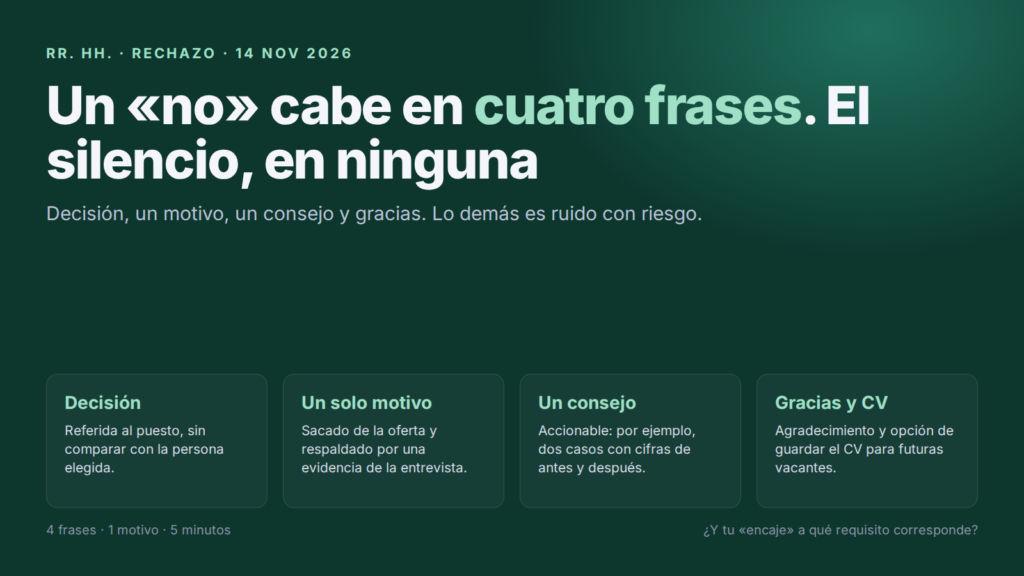
A good rejection email with feedback has four sentences: the decision in relation to the role, a single reason based on a requirement from the job ad, one concrete tip, and a thank-you with the option to keep the CV on file. It takes a few minutes to write if you decide on that reason beforehand and avoid ambiguous phrases about availability, age, family or “fit”.
What goes into a four-sentence rejection email with feedback?
The classic structure of a rejection message is simple: a greeting with the candidate’s details, a body with the reason for the decision and a closing thank-you. Aebys argues that explaining why helps the reader understand the decision without damaging their self-esteem. It also points out that someone who isn’t right today may be ideal for another role.
Here it is boiled down to a template you can copy and adapt:
Subject: Your application for [role] at [company]
Hi [name],
- After your interview on [date] for the [role] position, we’ve decided to continue the process with another candidate.
- The main reason is that the role requires [requirement from the job ad], and in the interview we didn’t see [specific evidence, for example: a case with measurable results].
- If you’d like to strengthen this, we suggest [actionable tip, for example: preparing two cases with before-and-after figures].
- Thank you for your time and interest; if you agree, we’ll keep your CV on file for future openings.
Best regards,
[Your name and title]
Notice what it leaves out: comparisons with the chosen candidate, adjectives about the person, vague promises of “we’ll be in touch” and more than one reason. Almost everything depends on that last point.
Is giving feedback mandatory?
It isn’t a general obligation in the hiring guides we’ve consulted. Indeed notes that giving feedback to rejected candidates isn’t mandatory, but that it can shape how they take the news and improve the brand’s reputation. That guide is written for a different legal context, so if your case has nuances, consult an employment law professional.
How do you choose the one reason that matters?
Almost every guide gives you the template and leaves you alone with the hard part. Whoever is hiring usually has five reasons for rejecting someone: little experience in the sector, a poorly explained case, doubts about their autonomy, salary, gut feeling. If you include them all, the message gets diluted and the candidate doesn’t know what to fix. And every extra reason is one more sentence someone could read in a way you didn’t intend.
Run each reason through these four filters and keep the one that passes them all:
- Is it in the job ad? If it wasn’t listed as a requirement for the role, it’s not a reason, it’s a preference.
- Do you have evidence from the interview? An answer, an exercise or a note from your interview guide. If all you have is an impression, drop it.
- Can the candidate act on it? A skill can be trained; a personality trait can’t. And it isn’t your place to judge it.
- Was it decisive? Ask yourself whether changing this would have changed the decision. If the answer is no, it doesn’t belong.
Whatever survives can almost always be written in one sentence and comes with its tip built in. If no reason passes the filters, you have a process problem, not a writing problem: without written criteria and notes there’s no honest feedback to give. A good remedy is to use an evaluation sheet for every interview; Workable recommends relying on scorecards so you can refer to concrete facts when giving feedback.
An example of a well-chosen reason
Five raw reasons: “little e-commerce experience”, “campaign case with no figures”, “asked for a higher salary than planned”, “we didn’t click” and “doubts about their autonomy”. Only the second passes all four filters: it’s in the job ad (proven track record of results), it’s in your notes, it can be worked on and it was decisive. That’s the one for sentence 2, and the tip for sentence 3 follows naturally.
Which phrases should you avoid so you don’t put your foot in it?
The problem is almost never bad intent; it’s ambiguity. According to Workable, even if you haven’t discriminated, your words can expose you to legal risk. These are the areas where people trip up most:
- Availability. Avoid “we were looking for someone without other commitments”. FlexJobs, citing Workable, warns that a phrase like this can be a problem if the person is a working mother or pregnant. If the role requires shifts or on-call duty, state the specific requirement as it appeared in the job ad.
- Age. “We were looking for more dynamic profiles” or “more energy” read as a reference to age. Workable gives the example that asking for “more energetic” candidates can sound discriminatory towards older people. Describe the behaviour or competence you observed, not the person.
- Family and personal circumstances. Don’t mention them or hint at them, not even with good intentions (“we understand you have other priorities right now”).
- “Fit” and “culture”. They’re catch-alls that say nothing. An Indeed guide cites phrases such as “we’ve gone in a different direction” or “our values don’t align” as examples of vague feedback. If you can’t translate “fit” into a requirement and a piece of evidence, don’t write it.
The basic rule fits on one line: only role requirements and evidence from the interview. Everything else stays out of the email.
How do you review it without spending an hour?
With two cheap habits. The first is to have a second evaluator (someone else who was in the process, or from HR) read the draft with a single question: does every statement come from the job ad or the interview notes? It takes two minutes and catches most slips.
The second is to turn the text into a template with blanks and reuse it: the role, the requirement, the evidence and the tip change; the structure stays. That way feedback stops being an act of courage and becomes a five-minute task. And if you thought giving feedback was complicated, think about the other side: asking for it after an interview is possible and simple, and being able to answer in four sentences makes it even easier.
When should you send it, and what if you have legal doubts?
As soon as possible. Indeed suggests sending feedback within a few days if you can, because it respects the candidate’s time and lets them get on with their search. Set an internal deadline (for example, one week after the interview) and stick to it.
This is a good-practice guide, not legal advice. If your company has specific policies, if the candidate has raised a complaint or if you’re unsure about a particular phrase, consult an employment law professional before sending it.
Our position
A short “no” with one reason and one tip is more honest and safer than silence or “after careful consideration…”. You don’t need to say everything: it’s enough to say one true, useful thing tied to the role. Decide on that reason before you open the editor and leave the rest out.
Frequently asked questions
How long should a rejection email with feedback be?
About four sentences: the decision in relation to the role, a single reason based on a requirement from the job ad, one concrete tip, and a thank-you with the option to keep the CV on file. If you need more, you’re probably including several reasons.
Which phrases should I avoid in a rejection email?
Those that refer to personal availability, age, family situation or an undefined “fit”. Replace them with the specific requirement of the role and the evidence observed in the interview.
Should someone else review the text before sending it?
Yes. A second evaluator can check in a few minutes that every statement comes from the job ad or the interview notes. If there are legal doubts, consult an employment law professional.
