How to ask for feedback after an interview without seeming pushy: the three-line email
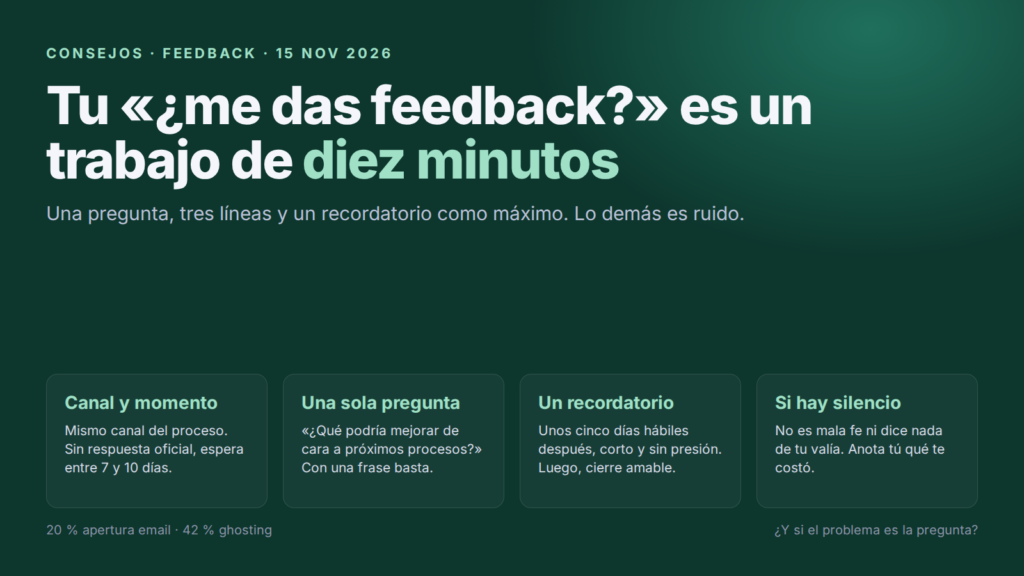
To ask for feedback without seeming pushy, send a single email through the same channel the process used. Keep it short, open with a thank-you and ask one specific question. If there’s no reply, you can send one reminder and, after that, a friendly closing note. Beyond that, it’s better to move on.
Which channel should you use, and when should you write?
The simplest channel is the one you’ve already been using with the company. If the process ran by email, reply in that same thread. If it ran through a job platform or LinkedIn, write there. Email has one clear advantage: according to Randstad, it lets the recruiter reply when they have time and leaves a written record.
As for timing, the same Randstad guide recommends waiting for the official outcome of the process. If it doesn’t arrive, it suggests letting 7 to 10 days pass after the interview. And it advises against asking right after the interview, unless the recruiter offers. If you were given a date for the decision, wait until it has passed.
Why does “Could you give me some feedback?” so often go unanswered?
Because it’s a huge question dressed up as a courtesy. To answer it well, the other person has to remember your interview, compare your profile with other candidates, decide what’s prudent to say and write it up. That’s ten minutes of work nobody asked them to do. And your message is competing with a full inbox.
The volume is real. Equipos y Talento reports that email, still the default method in most hiring processes, has an average open rate of 20%, according to Meta data.
How to read the 20% open-rate figure
It’s an average across emails sent in hiring processes, according to Meta and cited by Equipos y Talento. It doesn’t measure how many candidate emails asking for feedback get opened. Use it as a reminder that attention is scarce, not as an exact probability that you’ll be read.
That’s where the thesis of this post comes from: the less effort a question demands, the more likely someone is to answer it. It’s practical reasoning, not a study finding. Still, it matches what you see in any inbox: what can be answered in twenty seconds gets answered, and what needs careful writing gets put off.
On the evidence for this thesis
We haven’t found published data comparing the reply rate of a generic feedback email with that of a specific one. That’s why we don’t give percentages. What is clear is that follow-up guides agree on recommending short, specific messages.
What does the three-line email look like?
It has three parts: a sincere thank-you, a single question and an easy way out for whoever replies. No justifying yourself, no arguing with the decision and no attachments.
Subject: Thank you for the [role] process
Hi [Name],
Thank you for your time and for our conversation about the [role] position.
If you have a moment, what could I improve for future processes? One sentence would be plenty.
Best regards, and thanks again,
[Your name]
This template works for three reasons:
- A single question. “What could I improve?” can be answered in one sentence. “How did my interview go, why wasn’t I chosen and what do you think of my profile?” can’t.
- “One sentence would be plenty.” It lowers the effort expected of the person replying and gives them permission to be brief.
- A tone of thanks, not complaint. Avoid questions like “Why didn’t you choose me?”, which invite a defensive answer.
A variant if you were interviewed by a specific person
If you spoke with a team lead, you can sharpen the question a little: “Was there anything in how I explained [topic] that gave you doubts?” It’s more specific, but only use it if you remember a concrete moment. Otherwise, stick with the general version.
How many times can you follow up without overdoing it?
Once more, at most. Huru‘s guide suggests waiting at least five working days before resending your message. And it recommends keeping that reminder short and limited to recalling your request.
Hi [Name],
I’m just following up on my previous message. If you have a minute, any comment on what I could improve would be a great help. If that’s not possible, I completely understand.
Thanks again.
The phrase “I completely understand” matters. It takes the pressure off and makes clear that a reply is a favour, not an obligation. Two messages in total, the original and this reminder, is a reasonable limit.
What do you do if they don’t reply?
Close the loop yourself with a last short, grateful message. For example: “Thank you for the process; if something comes up in the future, I’d love to be considered.” Then move on. That message leaves the door open without adding pressure.
Don’t assume silence means bad faith. There may be an internal policy of not giving individual feedback, a high volume of applications, or your email may simply have got lost. Silence is common: according to LinkedIn Spain and Portugal data reported by Equipos y Talento, 42% of candidates have been ghosted at some point in their careers. Not getting a reply says nothing about your worth.
In the meantime, you can draw your own lessons. Write down which questions you struggled with, which examples you didn’t manage to explain well and what you wish you’d prepared. If there’s no reply, Huru also suggests asking other people involved in the process, or trusted colleagues, for their view.
What should you keep in mind when you send the message?
Asking for feedback after an interview is possible and simple. What makes it hard is framing it as a big request instead of a small question. My position is clear: a three-line email, a single question and one reminder at most. If there’s still no reply, you lose nothing, and you close the process with a professional image that may open doors in the future.
Frequently asked questions
How long should I wait before asking for feedback?
Ideally, wait for the official outcome of the process. If it doesn’t arrive, Randstad recommends letting 7 to 10 days pass after the interview. If the company gave you a date for the decision, wait until it has passed.
How many times can I write to ask for feedback?
Two messages is a reasonable limit: the original and a short reminder about five working days later. If there’s no reply, send a last thank-you message if you like and move on.
Which specific question is best to include in the email?
One that’s easy to answer in a sentence, such as “What could I improve for future processes?” Avoid questions that force them to justify the decision, such as “Why didn’t you choose me?”
