If an AI interviews you: five questions you can ask before you start
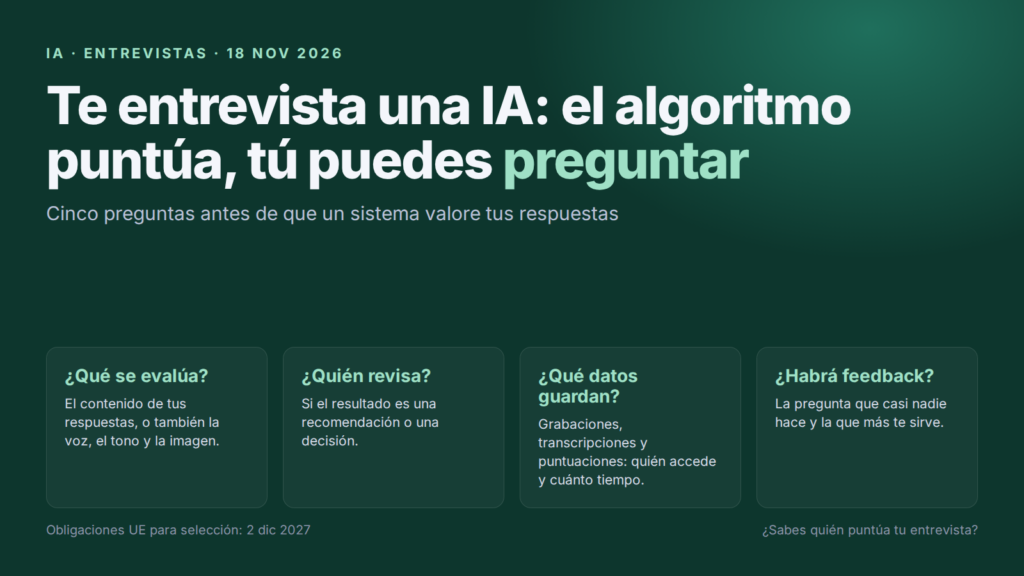
More and more candidates are facing a screening interview that isn’t led by a person but by an AI system. The news isn’t only technological: it changes what you can and can’t see of the process. Most guides teach you how to “beat the algorithm”, but almost none mention something simpler: you can ask how you’re being assessed. Here are five questions to do that before you start.
What’s happening with AI in interviews?
Two signals point the same way. The first is from business: according to RRHH Press, the Spanish start-up Orbio AI has closed a $21 million Series A led by Dawn Capital to develop AI agents covering the employee lifecycle, starting with hiring. In addition, COPE reports that Javier Martínez Torres, a lecturer at the University of Vigo, confirms that AI systems are already used to analyse interviews, even at companies with around 100 employees.
According to Ecosistema Startup, the company says that by automating CV screening, screening interviews and onboarding paperwork, time to hire falls by more than 60%.
How to read the efficiency figures
The time-saving figures (more than 60% across the whole process and 70% less administrative load) are those reported by the company itself, according to Ecosistema Startup, and we’re not aware of any third-party verification. They’re a useful reference for understanding why companies are interested in these tools, not an independent measure of their quality or of their effect on candidates.
For job seekers, the practical reading is different: the time the company saves shouldn’t come out of your right to understand the process. And understanding it starts with asking.
Which five questions can you ask before you start?
You can ask them by email when you confirm the appointment, to the recruiter, or at the start of the interview if the system allows it. They’re not demands: they’re reasonable questions that any well-prepared company should be able to answer.
1. What exactly is being assessed?
There’s a big difference between analysing the content of your answers and assessing other elements, such as your voice, tone or appearance. Ask which criteria are scored and whether they relate to the role. A phrase that works: “Before we start, could you explain which competencies are assessed in this interview?”
2. Who reviews the result?
Knowing whether the result is a recommendation or a decision changes everything. Ask whether a person reviews the system’s assessment before deciding whether you move forward. Martínez Torres argues, according to COPE, that “the human must always be in the loop”: the question helps you check that’s the case.
3. What data is stored, and for how long?
An AI interview can generate recordings, transcripts and scores. Ask what’s stored, who has access, how long it’s kept and how you can exercise your rights over that data. Until the AI Act’s specific obligations apply, the candidate’s tool in the EU is, according to Wwwhatsnew, the GDPR.
4. Will a person be involved, and at what point?
Knowing at which stage you’ll speak to someone lets you prepare and reduces uncertainty. Also ask whether you can request an alternative, such as an interview with a person, if you have any difficulty with the format (connection, disability, language).
5. Will I be able to get feedback on the result?
It’s the question almost nobody asks and the one that helps you most. Ask to know, even in a few lines, what was assessed well and what could be improved. Asking for feedback after an interview is possible and simple: a short, friendly message is enough, and with an AI involved the reason to do it is even clearer.
How do you ask without sounding distrustful?
Tone matters more than the question. Frame it as wanting to prepare well, not as an audit. An example for the confirmation email:
“Thank you for the invitation. To prepare better, could you tell me what will be assessed in the interview, whether a person will review the result and how my data will be handled? And, afterwards, would it be possible to receive some comments?”
If the answer is vague or doesn’t arrive, don’t take it as an attack: the company may not yet have worked out how to explain it. Note what they tell you and bear it in mind when deciding how to proceed in the process.
What do EU rules say, and what can you expect?
The EU AI Act classifies systems intended for recruitment and selection as high-risk, in particular those that filter applications or evaluate candidates, according to Wwwhatsnew. Its main obligations for these systems don’t apply until 2 December 2027. Until then, transparency will largely work on request, and asking for it is reasonable.
On the timeline and scope of this information
The timeline was postponed by the Omnibus Regulation (EU) 2026/1744, according to Naxia, which also notes that the transparency obligations in Article 50 have applied since 2 August 2026. This is general guidance, not legal advice: if you need to know what rights you have in a specific case, consult an employment or data protection lawyer.
And what should the interviewer explain?
If you’re on the other side, these five questions are also a to-do list. Before a candidate starts, you should be able to answer clearly:
- which criteria are assessed and why they relate to the role;
- who reviews the result and with what scope to correct it;
- what data is stored, who has access to it and for how long;
- at what point a person gets involved;
- how the candidate can receive a comment on their result.
Explaining it in the invitation email takes five lines and improves the candidate experience. A process that can be explained is usually also a process that’s easier to defend.
What’s Mentor Red’s position?
AI in hiring is already part of the landscape, and there’s no need to view it with fear or blind enthusiasm. What we do argue is that no automation should leave a candidate not knowing what’s measured, who decides and what happens to their data. Asking is a reasonable right and also a good way to learn from every process: with clear answers you’ll know what to prepare for, and without them you’ll know what kind of company you’re dealing with.
Frequently asked questions
Can I ask a company how an AI assesses me in the interview?
Yes. It’s a reasonable question you can ask by email before the interview or at the start. Ask which criteria are assessed, whether a person reviews the result, what data is stored and whether you’ll be able to receive comments. Do it in a friendly tone, as part of your preparation.
Is it normal for an AI to do the first interview?
It’s increasingly common. According to COPE, a University of Vigo lecturer confirms that AI systems are already used to analyse interviews, even at companies of around 100 employees. Being common doesn’t mean you should be in the dark about how it works.
What rights do I have over my data in an AI interview?
In the EU, until the AI Act’s specific obligations for hiring apply (expected on 2 December 2027), the main framework is the GDPR. For your specific case, consult an employment or data protection lawyer.
